

蓋婭科普講座系列
GAIA STEM Lectures Series
為了鼓勵更多優秀女青年學生對基礎科學的研究工作産生興趣,我們安排一個每月一次的線上科普講座,邀請全球傑出華人女科學家講述她們正在進行的前沿研究以及入門的秘訣。同學們参加這個講座,有機會和世界一流科學家對話和討論,一方面可以吸收新知,一方面也可以從中尋找她們的楷模和方向,所以非常歡迎報名参加。
主持人 / Moderator
施如齡 教授 ( 國立中央大學 網路學習科技研究所 )

即將舉行 / Coming Next
【蓋婭科普講座系列】
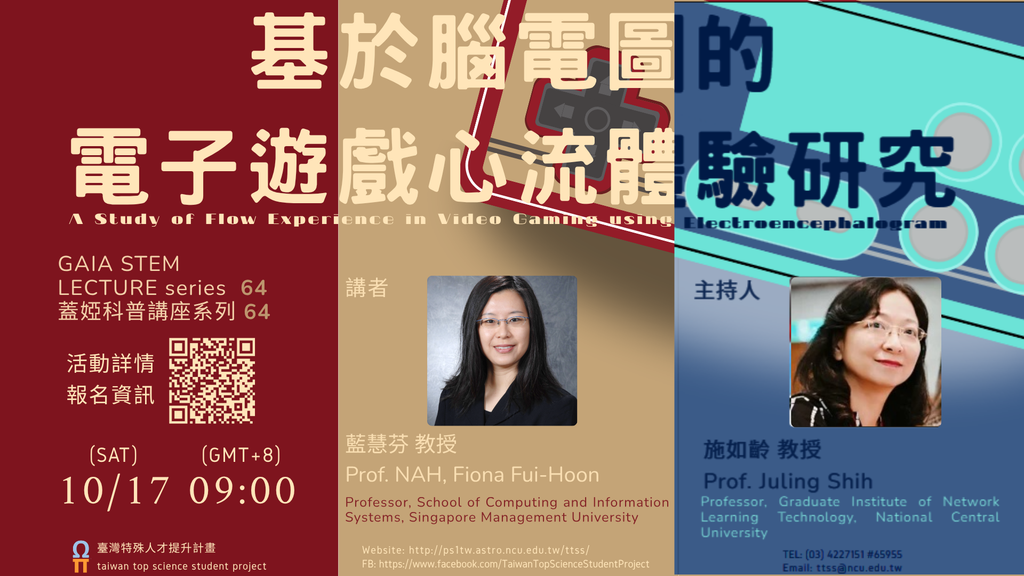
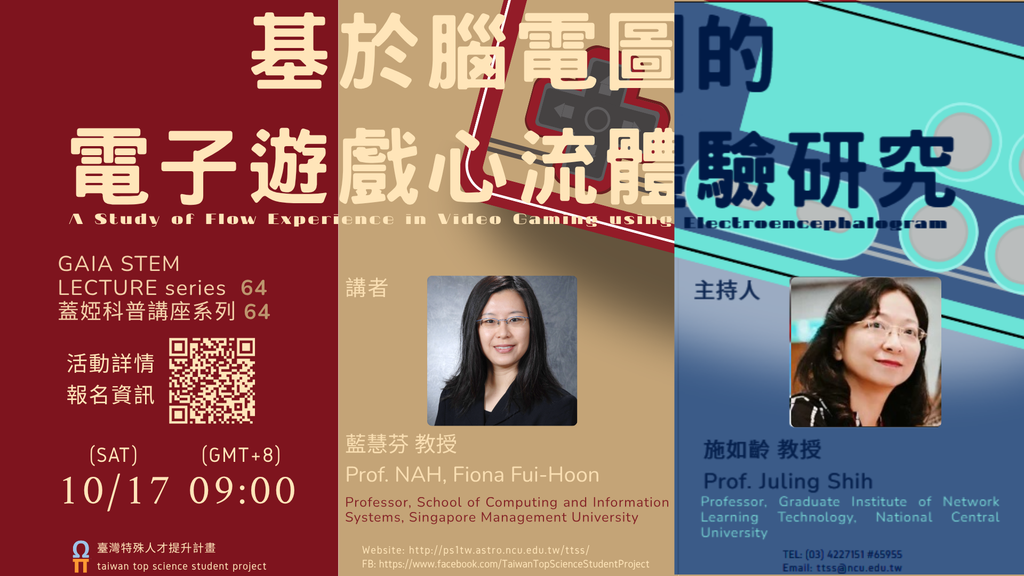
講題:A Study of Flow Experience in Video Gaming using Electroencephalogram (EEG) (基於腦電圖(EEG)的電子遊戲心流體驗研究 )
講者:Prof. NAH, Fiona Fui-Hoon ( 藍慧芬 教授)
日期及時間 : 10/17 (六) 上午 9:00 (GMT+8)
*會議連結將於活動前一天發送至您的信箱 The Link will be sent to your email the day before the lecture, thank you.
藍慧芬教授
Prof. NAH, Fiona Fui-Hoon
Introduction / 簡介
Fiona Fui-Hoon NAH is a Professor in the School of Computing and Information Systems at Singapore Management University. She has been awarded numerous academic distinctions in her field, including Fellow of the Association for Information Systems (AIS). While her research interests vary from Human-Computer Interaction to Information Systems Management, her work primarily focuses on building a solid psychological understanding of human-computer interaction to design better interfaces. Additionally, according to a study by Stanford University, Professor NAH is one of the world’s top 2% most-cited scientists. She obtained her Ph.D. at the University of British Columbia, and her master’s and bachelor’s degrees at the National University of Singapore.
Fiona Fui-Hoon NAH是新加坡管理大學計算與資訊系統學院的教授,曾獲多項學術榮譽。雖然她的研究興趣從人機互動廣泛涵蓋至資訊系統管理,但她主要研究目標聚焦於替人機互動建構穩固的心理學基礎,進而設計出更優秀的介面。此外,根據史丹佛大學的一項統計指出,NAH教授為論文引用次數名列全球前2%的科學家。她過去於英屬哥倫比亞大學取得博士學位,在此之前,她於新加坡國立大學獲得了碩士與學士學位。
Research Areas / 研究範疇
Human-Machine Collaborative Systems 人機協作系統
Human-Computer Interaction 人機互動
Information Systems & Technology 資訊系統與科技
Information Systems Management 資訊系統管理
Neuro-IS 神經資訊系統
Generative Artificial Intelligence 生成式人工智慧
Metaverse & Virtual Worlds 元宇宙與虛擬世界
Important experience / 重要經歷
Professor, School of Computing and Information Systems, Singapore Management University
新加坡管理大學 計算與資訊系統學院 教授
Fellow of the Association for Information Systems, AIS (2025)
2025年獲國際資訊系統協會會士榮譽
Recipient, Top 50 Asia Women Tech Leaders Award (2024)
亞洲前50大科技女性領袖獎得主 2024年
First Place, Daniel J. Power Best Paper Award, Midwest Association for Information Systems Conference (2021)
美國中西部資訊系統協會會議 Daniel J. Power最佳論文獎 第一名 2021年
Recipient, Sandra Slaughter Service Award, Association for Information Systems (2021)
資訊系統協會 Sandra Slaughter 服務獎得主 2021年
Ph.D., Management Information Systems, University of British Columbia
英屬哥倫比亞大學 管理資訊系統博士
M.S., Computer and Information Sciences, National University of Singapore
新加坡國立大學 電腦與資訊科學碩士
B.S. (Honours), Computer and Information Sciences, National University of Singapore.
新加坡國立大學 電腦與資訊科學榮譽學士
More about the speaker/ 更多關於講者
◆ https://computing.smu.edu.sg/faculty/profile/7861/nah-fiona-fui-hoon
◆ https://scholar.google.com/citations?user=TuqWAMQAAAAJ&hl=en
Lecture Exploration / 講座探索
Previous lectures / 講座回顧













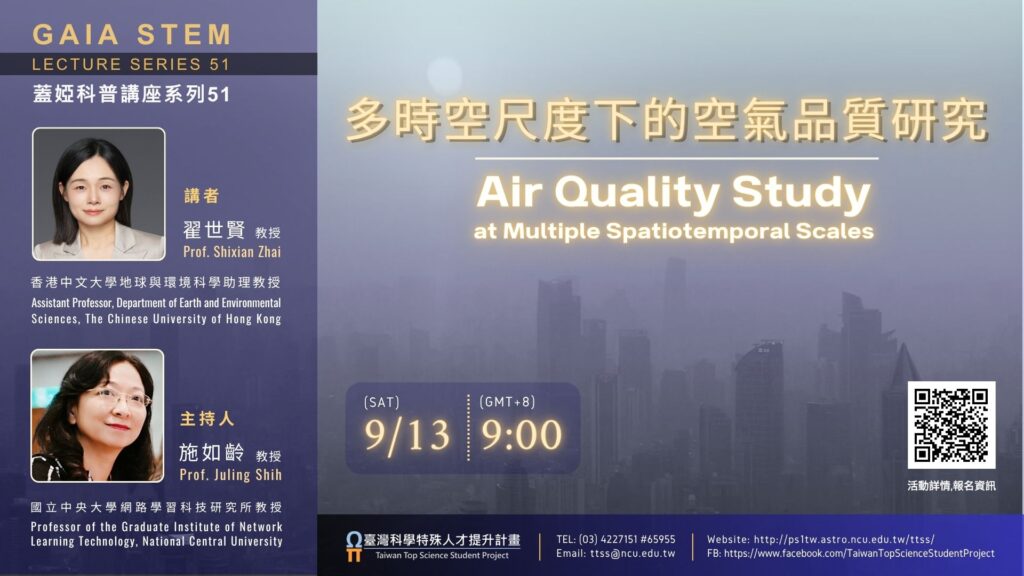
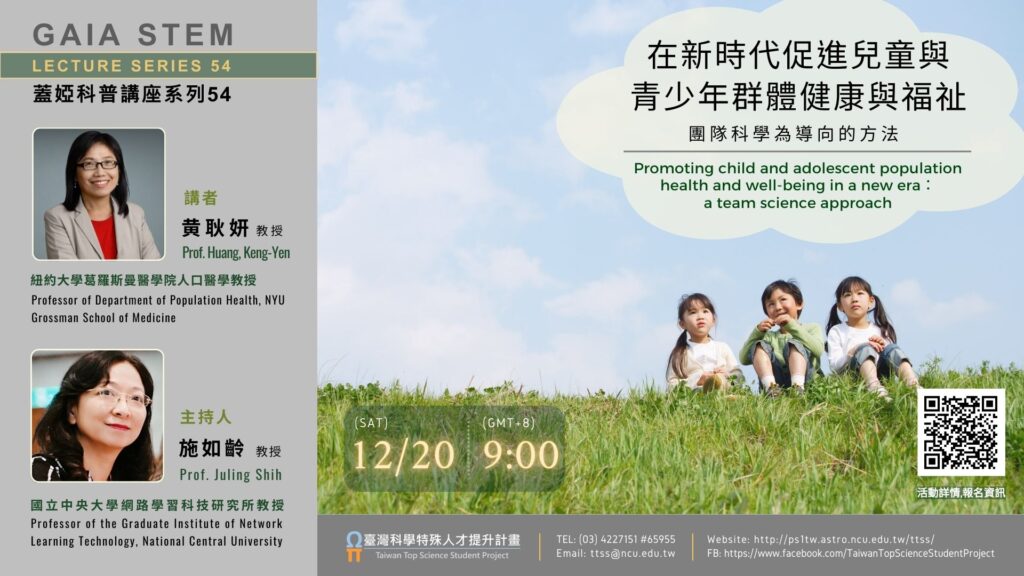
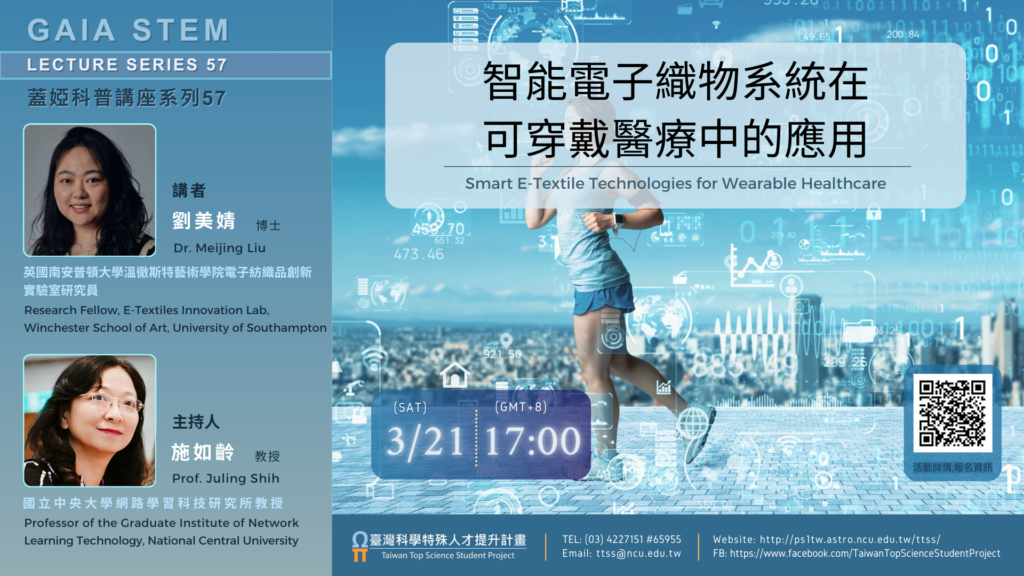
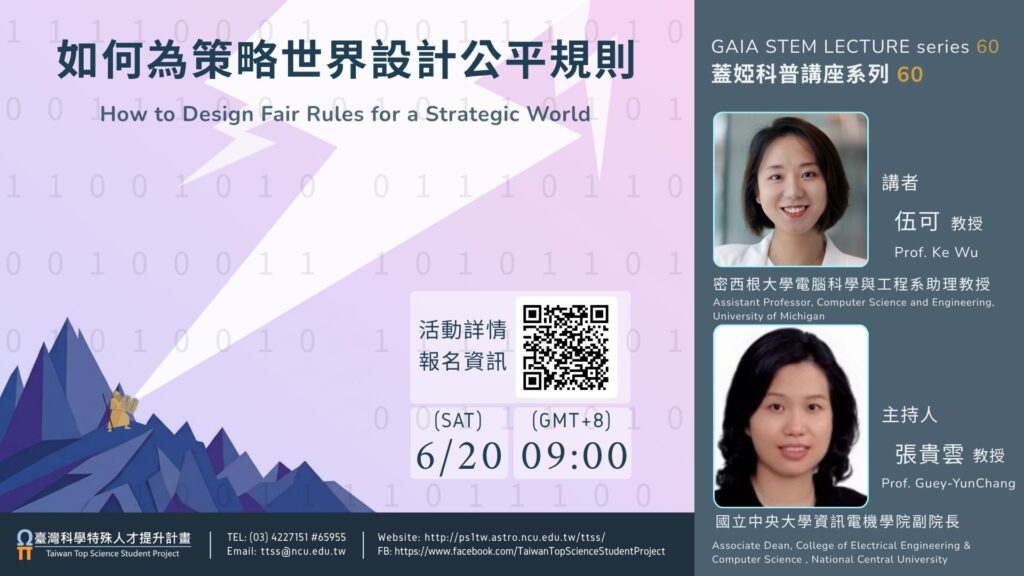
Related Books / 相關書籍
Schedule