2021/6/19 (六)
上午9:00 (GMT+8) | Semiconductor Technology – from Atoms to Applications (半導體科技 – 從原子到應用 ) – Prof. Tsu-Jae King Liu (劉金智潔 教授) |
2021/7/17 (六)
上午9:00 (GMT+8) | Using Light for Biomedical Imaging (用光學顯微鏡成像來研究生物醫學) – Prof. Lingyan Shi (石玲燕 教授) |
2021/ 8/14 (六)
上午9:00 (GMT+8) | A perspective of modern frontiers in nanoscience and nano-technology (現代前沿的觀點——納米科學和納米技術) – Prof. Nai-Chang Yeh (葉乃裳教授) |
2021/ 9/18 (六)
上午9:00 (GMT+8) | Gravity’s Fatal Attraction: Black Holes at the Centers of Galaxies (重力的致命吸引力:星系中心的黑洞) – Prof. Chung-Pei Ma (馬中珮 教授) |
2021/ 10/16 (六)
上午9:00 (GMT+8) | Neutrinos: a Window into Physics at the Early Universe (微中子:了解早期宇宙物理學的窗口) – Prof. Mu-Chun Chen (陳慕群 教授) |
2021/ 11/20 (六)
(GMT+8) | COVID-19 and Aerosols (COVID-19與氣膠)- Prof. Chia Chun Wang (王家蓁 教授 ) |
2021/ 12/18 (六)
上午9:00 (GMT+8) | GEOSPACE: The protective layer of our home planet (地球空間: 我們地球的保護層) – Dr. Gang Lu |
2022/1/15 (六)
上午9:00 (GMT+8) | 多才多藝的MAO酶 – Prof. Jean Chen Shih (陳景虹 教授) |
2022/2/19 (六)
上午9:00 (GMT+8) | Virtual Language Coaches Powered by Artificial Intelligence (用人工智慧教你說任何語言 – Dr. Nancy F. Chen (陳方玉博士)
|
2022/3/19 (六)
上午9:00 (GMT+8) | 全球暖化加速地震的發生嗎? – Prof. Hui-Hsuan Chen (陳卉瑄 教授) |
2022/4/23 (六)
上午9:00 (GMT+8) | Quantum Matter, Why it matters? (量子物質為何重要?) – Prof. Xie Chen (陳諧 教授)
|
2022/6/18 (六)
上午9:00 (GMT+8) | Aggregation-Induced Emission: Materials and Biomedical Applications (聚集誘導發光:材料及生物醫學應用) – Prof. Bin Liu (劉斌 教授) |
2022/7/16 (六)
下午4:00
(GMT+8) | Brain Computer Interfaces (BCI) for Therapy (治療用的腦機介面) – Prof. Huiling Tan (譚惠玲 教授) |
2022/8/20 (六)
上午9:00 (GMT+8) | Application of particle tracking on ocean research (粒子追蹤與海洋研究) – Dr. Yu-lin Chang (張育綾 博士) |
2022/9/17 (六)
上午9:00 (GMT+8) | The Search for Life on Planets in Other Solar Systems: Biosignatures from Photosynthesis (在系外行星尋找生命:光合作用的生命印跡) – Dr. Nancy Y. Kiang (江耀蘭博士) |
2022/10/15 (六)
下午4:00 (GMT+8) | When Computer Science meets Education (當計算機科學遇上教育) – Prof. Jingyun Wang (王靜芸 教授) |
2022/11/19 (六)
上午9:00 (GMT+8) | Post-translational Modifications in autoimmunity: the story beyond the 20 amino acids (20個氨基酸以外的免疫故事) – Prof. Mei-Ling Yang (楊美齡 教授) |
2022/12/17 (六)
上午9:00 (GMT+8) | Across the Indo-Pacific Ocean: Ancient Austronesian Courage, Wisdom and Journey (穿越印度洋-太平洋: 史前南島民族的勇氣, 智慧與旅程) – Prof. Hsiao-chun Hung (洪曉純 教授) |
2023/1/28 (六)
上午9:00 (GMT+8) | The Fantastic Voyage: Chemical Processing of Function Accelerated nano-Materials at the Atomic Scale – Prof. Jane P. Chang |
2023/2/18 (六)
上午9:00 (GMT+8) | Evolving the Internet into the Future via Named Data (發展網際網路新未來—命名資料) – Prof. Lixia Zhang (張麗霞 教授) |
2023/3/18 (六)
上午9:00 (GMT+8) | On Human-Environmental Relationships: Putting waste management and circular economy in the context of biogeochemical cycles (淺談人與自然的互動:以廢棄物管理、循環經濟在生物地球化學循環中所扮演的角色為例) – Dr. Yu-Ting Tang (唐郁婷 博士) |
2023/4/15 (六)
上午9:00 (GMT+8) | Upcycling Plastic Wastefor a Circular Economy (為循環經濟創造性再利用塑膠廢棄物) – Prof. Wan-Ting Chen (陳琬婷教授) |
2023/5/20 (六)
下午4:00 (GMT+8) | Sociocultural and Psychological aspects of Bilingual Learning (雙語學習中的社會文化及心理反應) – Dr. Yu-Chiao Chung (鍾于喬博士) |
2023/6/17 (六)
上午9:00 (GMT+8) | Personalized Immunotherapy for Brain Cancer (腦癌的個性化免疫療法) – Prof. Linda M. Liau (廖敏妃 教授) |
2023/7/22
(六)
上午9:00 (GMT+8) | Think Spatially: Developing your spatial skills with GIS and spatial analytics (空間思考:通過 GIS 和空間分析培養空間技能) – Prof. Yan Liu (劉艷 教授) |
2023/8/19
(六)
上午9:00 (GMT+8) | History of the Monster Black Hole at the Center of our Galaxy (銀河系中心超大質量黑洞簡史) – Prof. Shuo Zhang (張爍 教授) |
2023/9/24
(日)
上午9:00 (GMT+8) | Application of Analytical Chemistry in Food and Flavor Research (分析化學在食品和風味研究中的應用) – Prof. Yu Wang (王玉 教授) |
2023/10/21
(六)
下午4:00 (GMT+8) | What does chemistry have to do with my binocular vision? (化學與我的雙眼視力有什麼關係?) – Dr. Betina Ip (葉亦帆 博士) |
2023/11/18
(六)
下午4:00 (GMT+8) | Exploring the Universe with Gravitational Lensing (透過重力透鏡探索宇宙 ) – Prof. Sherry H. Suyu (蘇游瑄 教授) |
2023/12/16
(六)
上午9:00 (GMT+8) | Statistical learning contributes to native and foreign language acquisition (統計學習能力對母語和外語學習的貢獻) – Prof. Denise Hsien Wu (吳嫻 教授) |
2024/1/6 (六)
下午5:00 (GMT+8) | Why am I so fascinated about Transport Planning? (為什麼我對運輸規劃如此著迷?) – Prof. Judith Wang (王猶弟 教授) |
2024/2/24 (六)
上午9:00 (GMT+8) | Particulate Matter: Sources of Pollution, Chemistry, and Impacts on Health (懸浮微粒:污染的來源、化學及對健康的影響) – Prof. Nga Lee (Sally) Ng (吳雅莉 教授) |
2024/3/16 (六)
上午9:00 (GMT+8) | Space Weather Impact on Our Technology (太空天氣對現代科技的影響) – Dr. Tzu-Wei Fang (方慈瑋 博士) |
2024/4/20 (六)
上午9:00 (GMT+8) | Fire Projection Engineering Fire Modeling & Simulation (我們能建立和使用電腦模型來抵禦火災嗎) – Prof. Xiaolei Chen
|
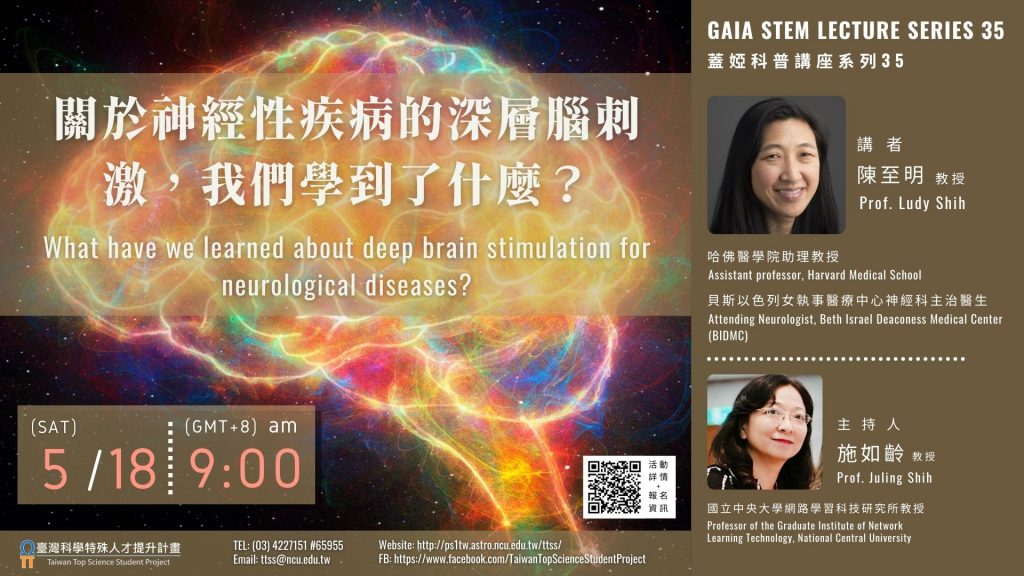
2024/5/18 (六)
上午9:00 (GMT+8) | What have we learned about deep brain stimulation for neurological diseases? (關於神經性疾病的深層腦刺激,我們學到了什麼?) – Prof. Ludy Shih (陳至明 教授)
|
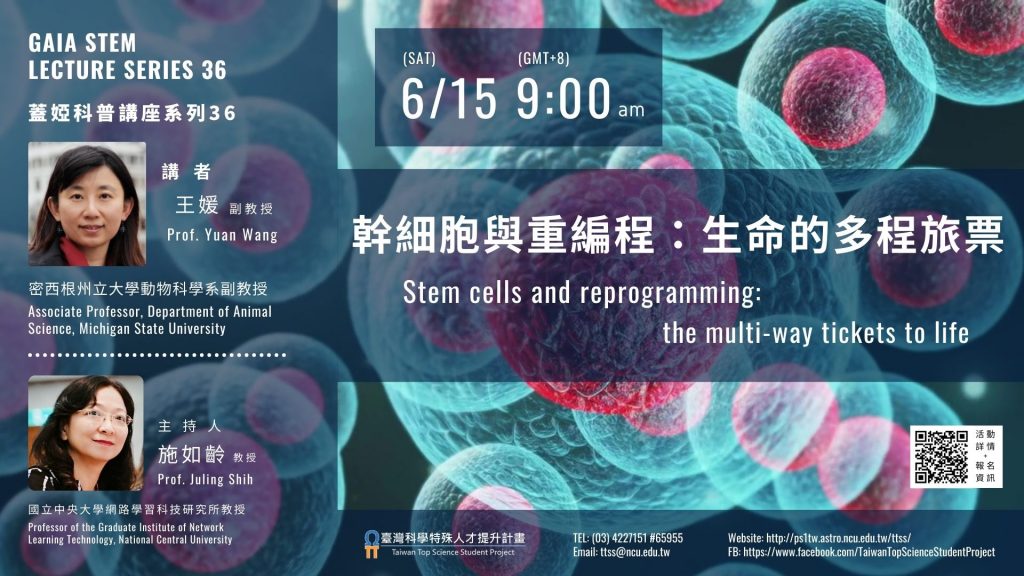
2024/6/15 (六)
上午9:00 (GMT+8) | Stem cells and reprogramming: the multi-way tickets to life (幹細胞與重編程:生命的多程旅票) – Prof. Yuan Wang (王媛 教授) |
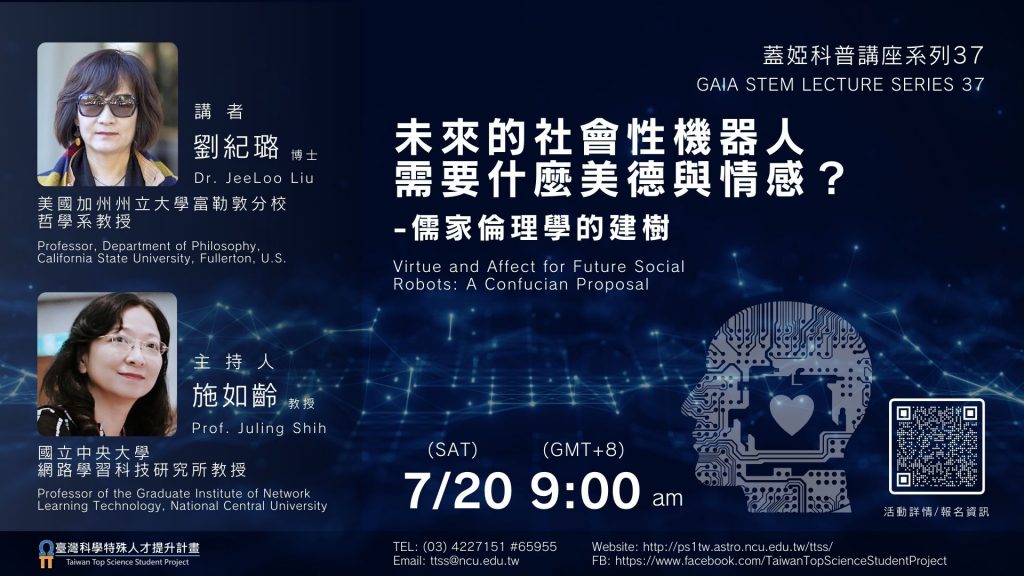
2024/7/20 (六)
上午9:00 (GMT+8) | Virtue and Affect for Future Social Robots: A Confucian Proposal (未來的社會性機器人需要什麼美德與情感?儒家倫理學的建樹) – Dr. JeeLoo Liu (劉紀璐 博士) |
2024/8/17 (六)
下午4:00 (GMT+8) | The Role of Geoscience in Energy Transition (地球科學在能源轉型中的角色) – Dr. Lin Ma (馬琳 博士) |
2024/9/21
(六)
上午9:00 (GMT+8) | Advanced (Photo)oxidation Processes for Water Treatment (高級光氧化過程於水處理的應用) – Dr. Ching-Hua Huang (黃京華 博士) |
2024/10/19
(六)
下午4:00 (GMT+8) | Can Industry 4.0 Help Achieve Sustainable Transformations? (工業4.0技術能幫助實現永續轉型嗎?) – Dr. Lai Xu (徐來 博士) |
2024/11/16
(六)
上午9:00 (GMT+8) | From Curiosity to Creation: Developing Statistical Models for Natural Hazards (從好奇到創造:開發自然災害的統計模型) – Dr. Ting Wang (王婷 博士) |
2024/12/21
(六)
上午9:00 (GMT+8) | Dynamic chemistry and toxicity of e-cigarette aerosols and their product waste (電子菸氣溶膠及其產品廢棄物的動態化學和毒性) – Prof. Ying-Hsuan Lin (林穎萱 教授) |
2025/1/18
(六)
上午9:00 (GMT+8) | Phase Transition in 2D Materials and Their Application (新型二維材料中的相變及其應用) – Prof. Ying Wang |
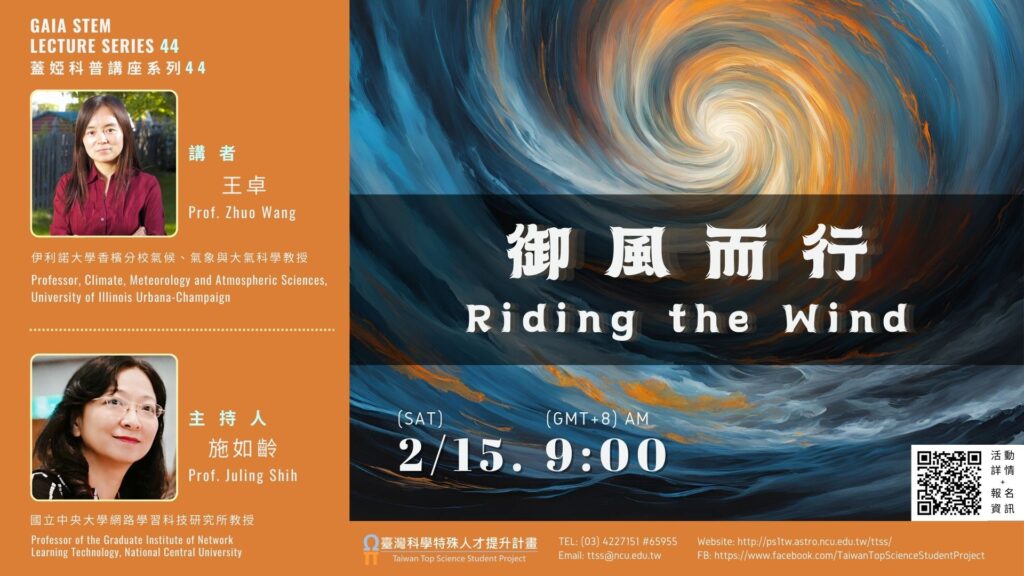
2025/2/15
(六)
上午9:00 (GMT+8) | Riding the Wind: The Formation and Intensification of Tropical Cyclones (御風而行:熱帶氣旋的形成與增強) – Prof. Zhuo Wang (王卓 教授) |
2025/3/15
(六)
上午9:00 (GMT+8) | GeoAI in Human-Environment Interaction (人類與環境交互作用中的地理空間人工智慧) – Prof. Siqin (Sisi) Wang |
2025/4/19
(六)
上午9:00 (GMT+8) | Spatial Statistics and Environment (空間統計和環境) – Prof. Bo Li |
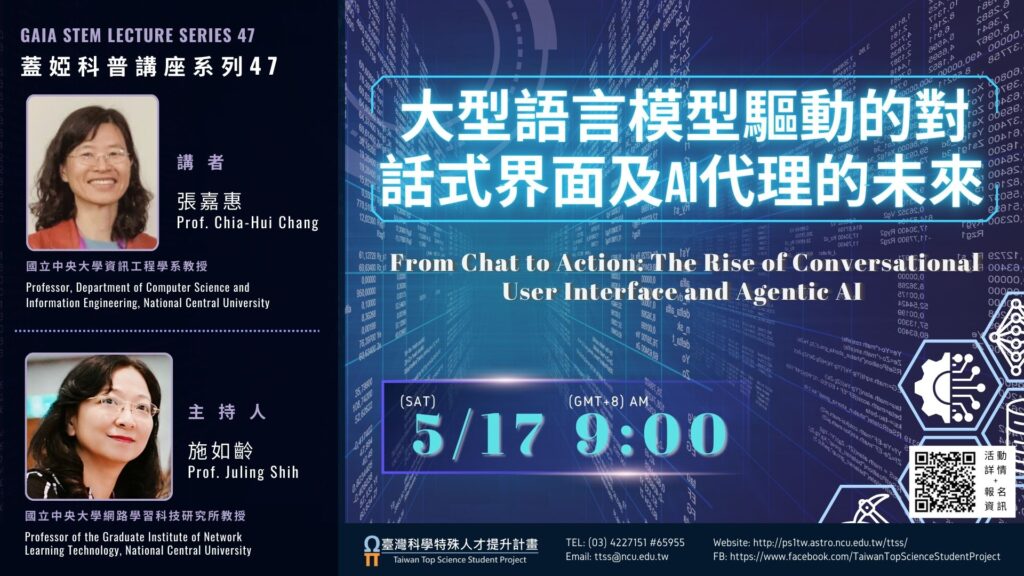
2025/5/17
(六)
上午9:00 (GMT+8) | From Chat to Action: The Rise of Conversational User Interface and Agentic AI (大型語言模型驅動的對話式界面及AI代理的未來) – Prof. Chia-Hui Chang (張嘉惠 教授) |
2025/6/21 (六)
上午9:00 (GMT+8) | Historic and Future Extreme Climate Assessments over Arid and Semi-Arid Regions and the Applications for Risk Management (穿越古今:乾旱與半乾旱地區極端氣候的評估與風險管理應用) – Prof. Hsin-I Chang (張心儀 教授)
|
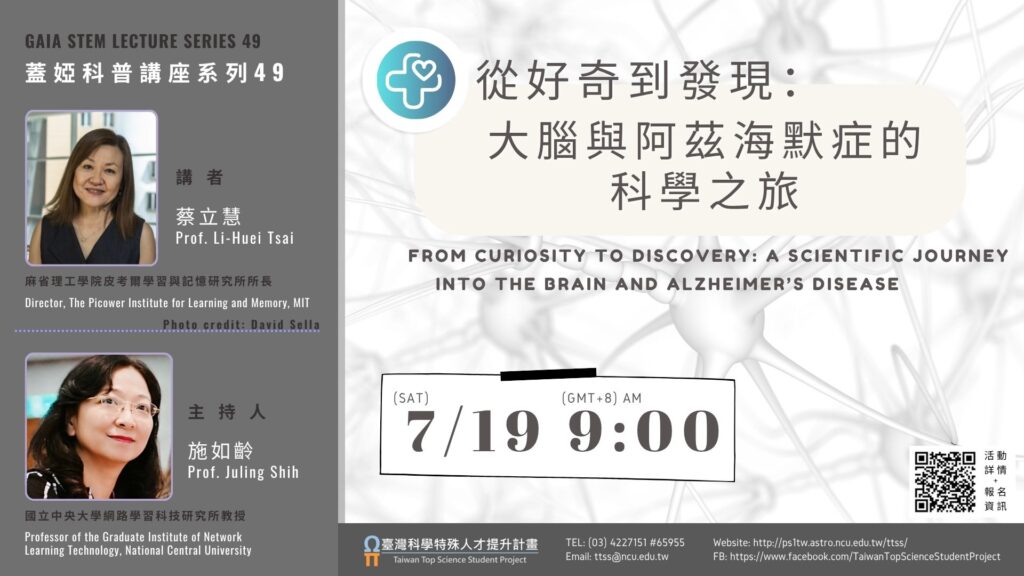
2025/7/19 (六)
上午9:00 (GMT+8) | From Curiosity to Discovery: A Scientific Journey into the Brain and Alzheimer’s Disease (從好奇到發現:大腦與阿茲海默症的科學之旅) – Prof. Li-Huei Tsai (蔡立慧 教授)
|
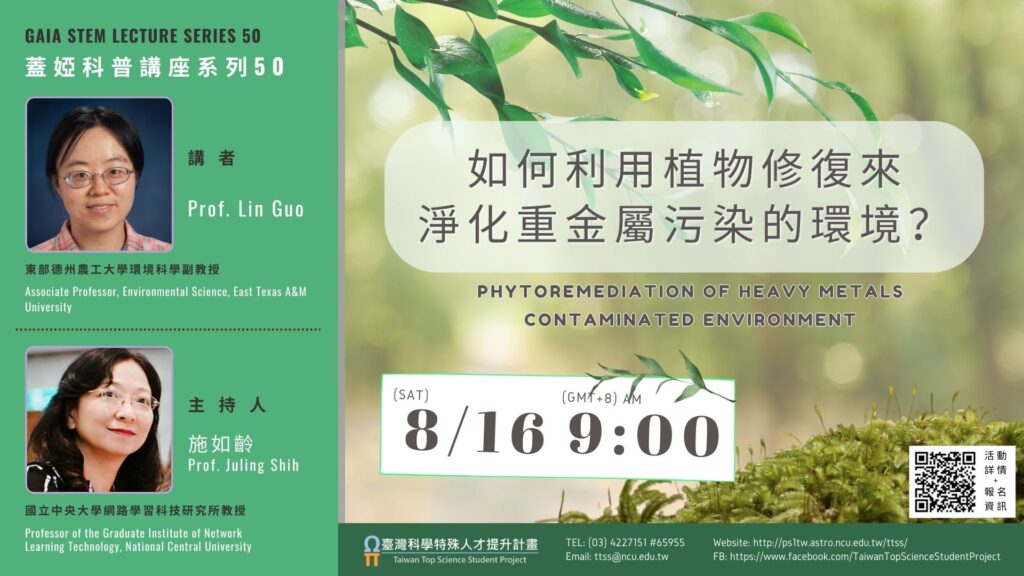
2025/8/16
(六)
上午9:00 (GMT+8) | Phytoremediation of heavy metals contaminated environment (如何利用植物修復來淨化重金屬污染的環境?) – Prof. Lin Guo
|
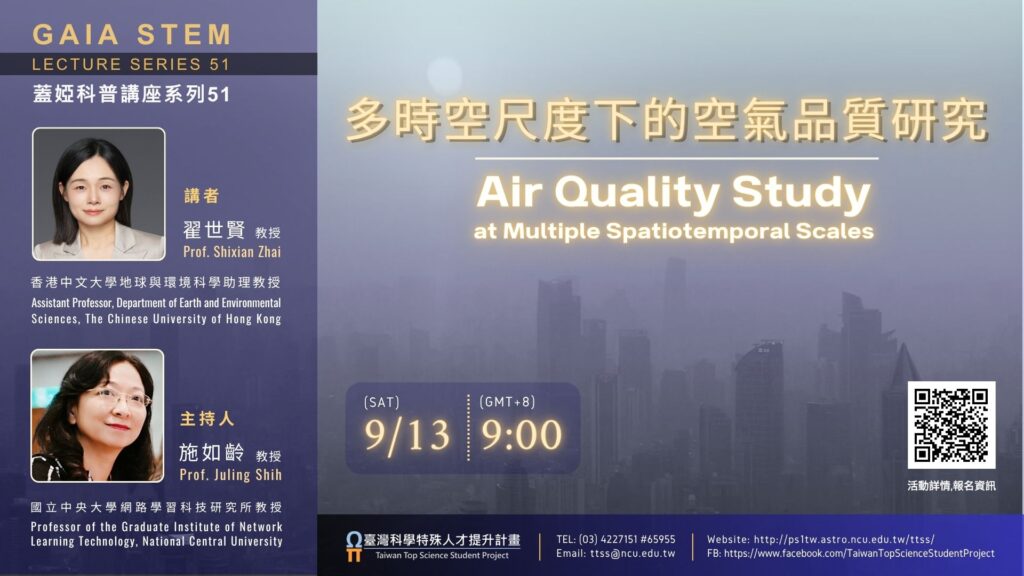
2025/9/13
(六)
上午9:00 (GMT+8) | Air quality study at multiple spatiotemporal scales (多時空尺度下的空氣品質研究) – Prof. Shixian Zhai (翟世賢 教授)
|
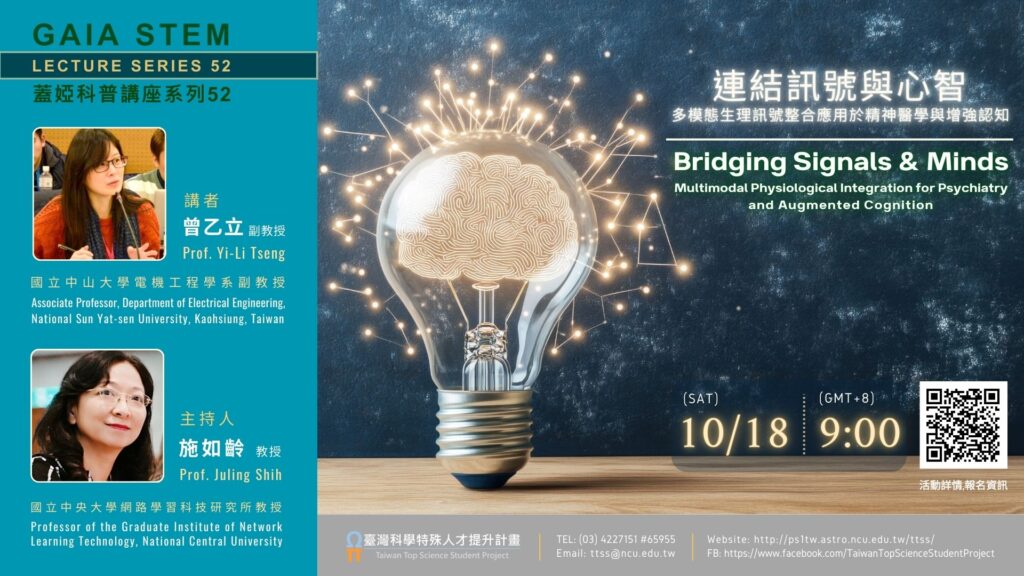
2025/10/18
(六)
下午4:00 (GMT+8) | Bridging Signals and Minds: Multimodal Physiological Integration for Psychiatry and Augmented Cognition (連結訊號與心智:多模態生理訊號整合應用於精神醫學與增強認知) – Prof. Yi-Li Tseng (曾乙立 教授)
|
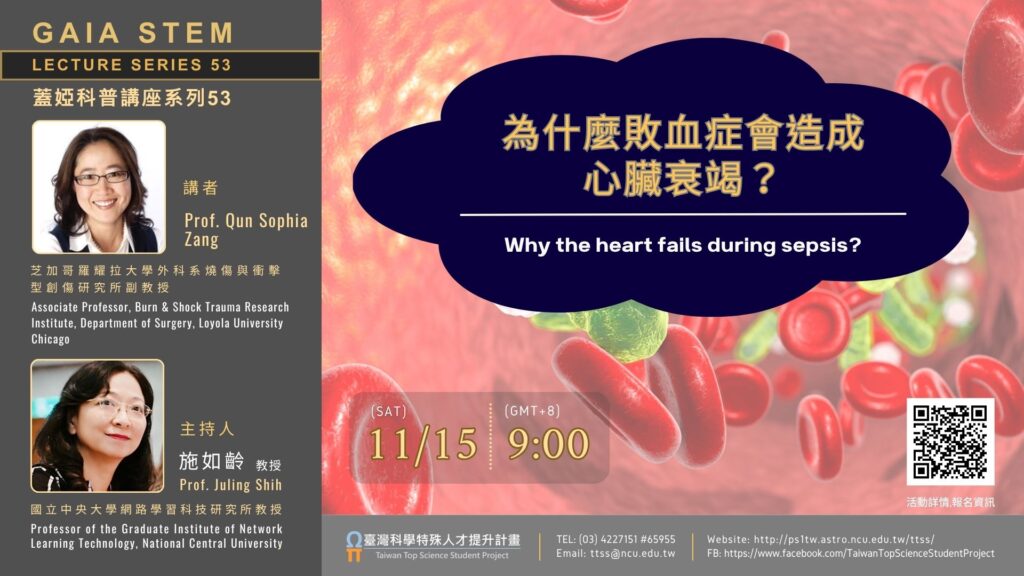
2025/11/15 (六)
上午9:00 (GMT+8) | Why the heart fails during sepsis? (為什麼敗血症會造成心臟衰竭?) – Prof. Qun Sophia Zang |
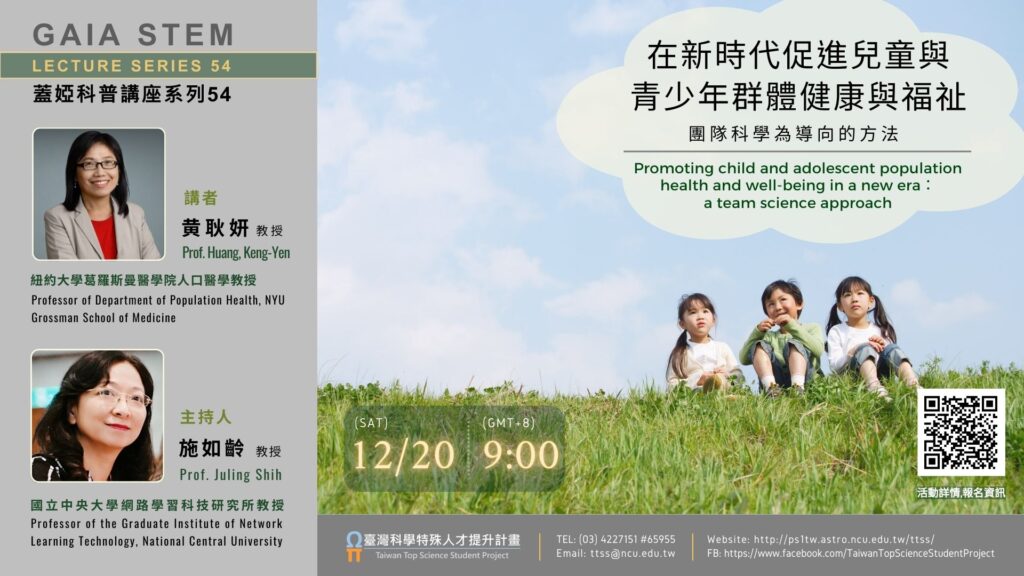
2025/12/20 (六)
上午9:00 (GMT+8) | Promoting child and adolescent population health and well-being in a new era: a team science approach (在新時代促進兒童與青少年群體健康與福祉:團隊科學為導向的方法) – Keng-Yen Huang (黃耿妍 教授) |
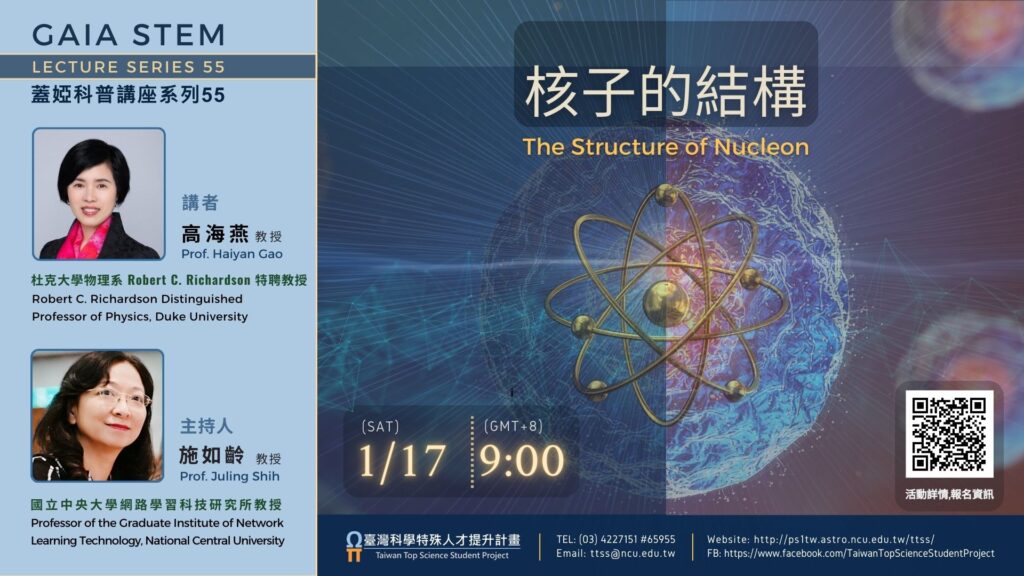
2026/1/17 (六)
上午9:00 (GMT+8) | The Structure of the Nucleon (核子的結構) – HaiYan Gao (高海燕 教授) |
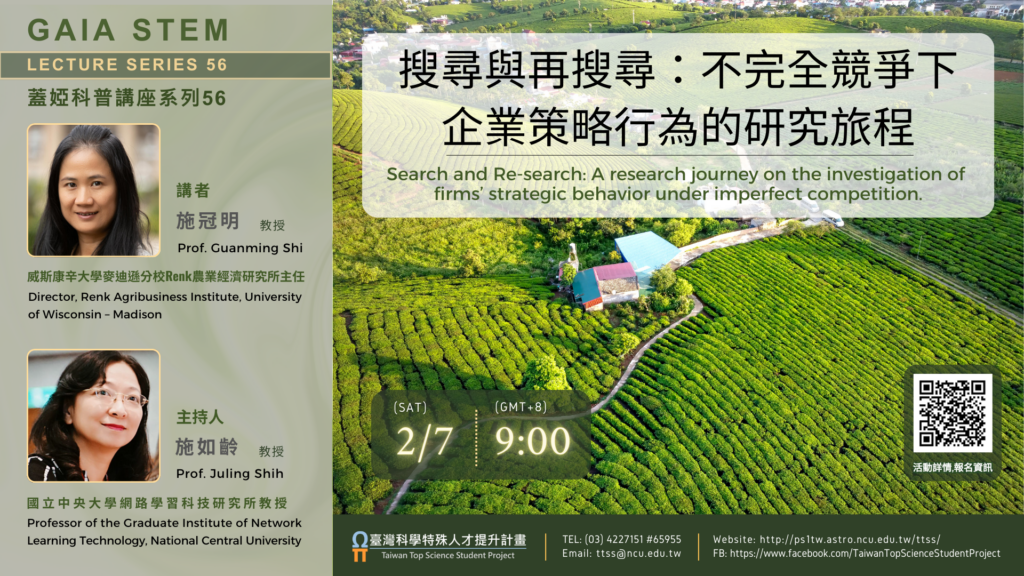
2026/2/7 (六)
上午9:00 (GMT+8) | Search and Re-search: A research journey on the investigation of firms’ strategic behavior under imperfect competition. (搜尋與再搜尋:不完全競爭下企業策略行為的研究旅程) – Prof. Guanming Shi (施冠明 教授) |
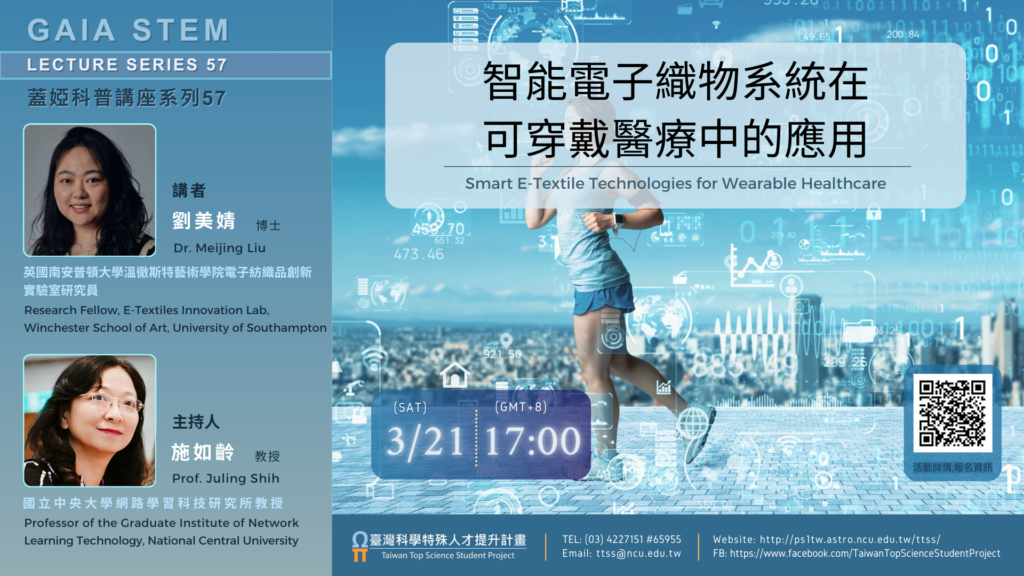
2026/3/21 (六)
下午5:00 (GMT+8) | Smart E-Textile Technologies for Wearable Healthcare (智能電子織物系統在可穿戴醫療中的應用) – Dr. Meijing Liu (劉美婧 博士) |
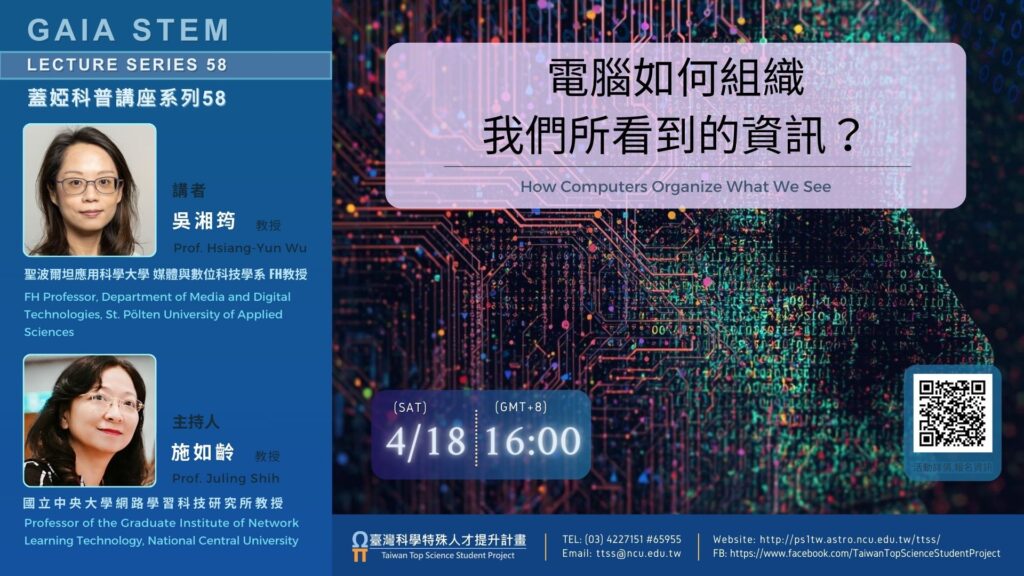
2026/4/18 (六)
下午4:00 (GMT+8) | How Computers Organize What We See (電腦如何組織我們所看到的資訊?) – FH-Prof. Wu Hsiang-Yun (吳湘筠 FH教授) |
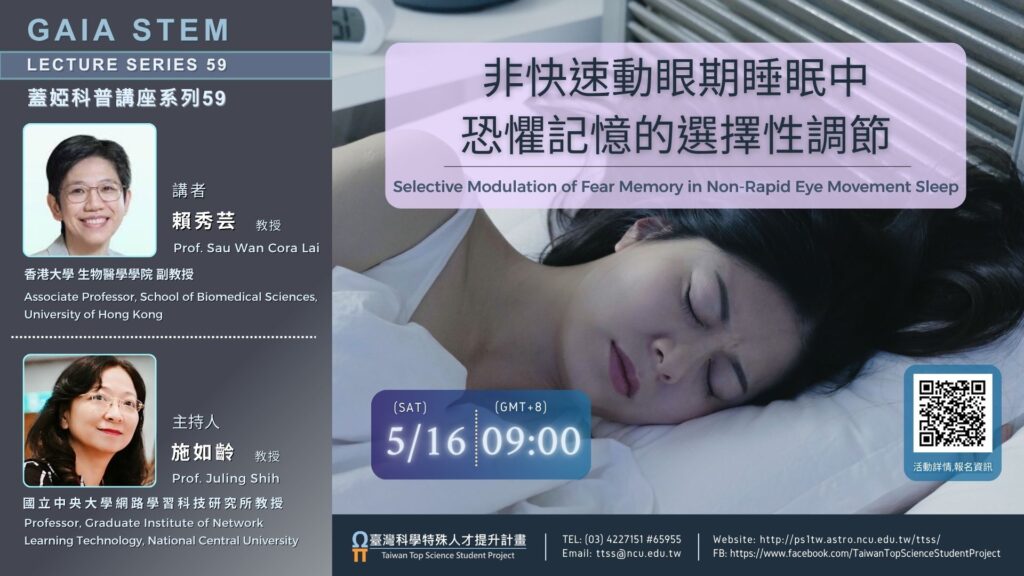
2026/5/16 (六)
上午9:00 (GMT+8) | Selective Modulation of Fear Memory in Non-Rapid Eye Movement Sleep (非快速動眼期睡眠中恐懼記憶的選擇性調節) – Prof. Sau Wan Cora Lai (賴秀芸 教授) |
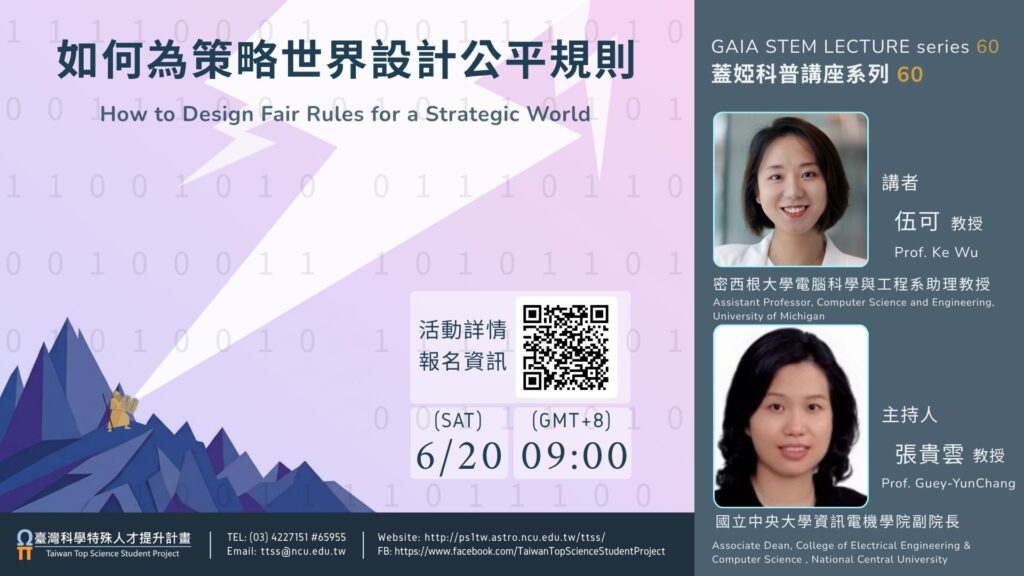
2026/6/20 (六)
上午9:00 (GMT+8) | Humanizing Technology: When Intractable Problems Need Interdisciplinary Solutions (如何為策略世界設計公平規則) – Prof. Ke Wu ( 伍可 教授)
|
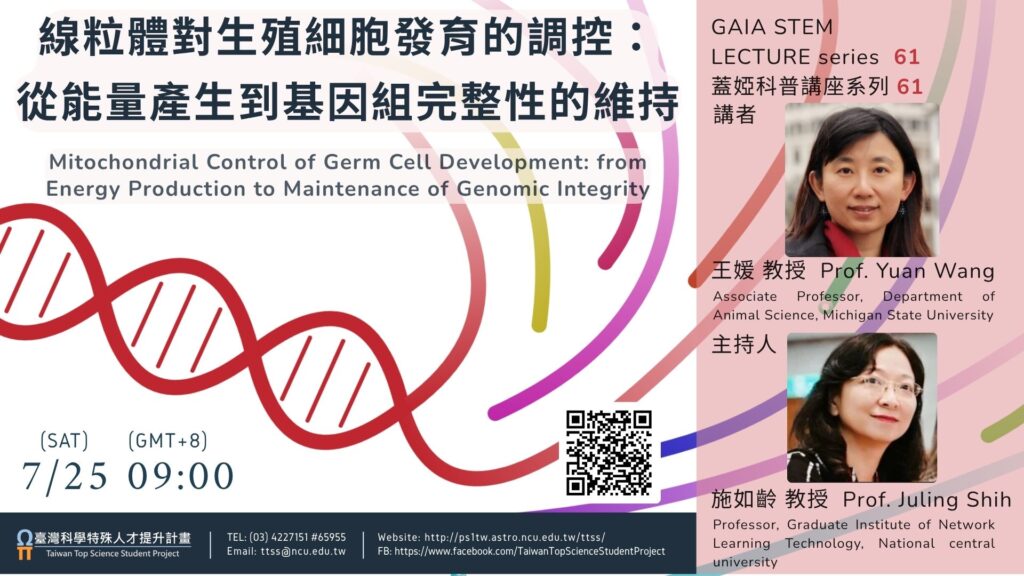
2026/7/25 (六)
上午9:00 (GMT+8) | Mitochondrial Control of Germ Cell Development: from Energy Production to Maintenance of Genomic Integrity. (線粒體對生殖細胞發育的調控:從能量產生到基因組完整性的維持) – ( 王媛 教授 ) |
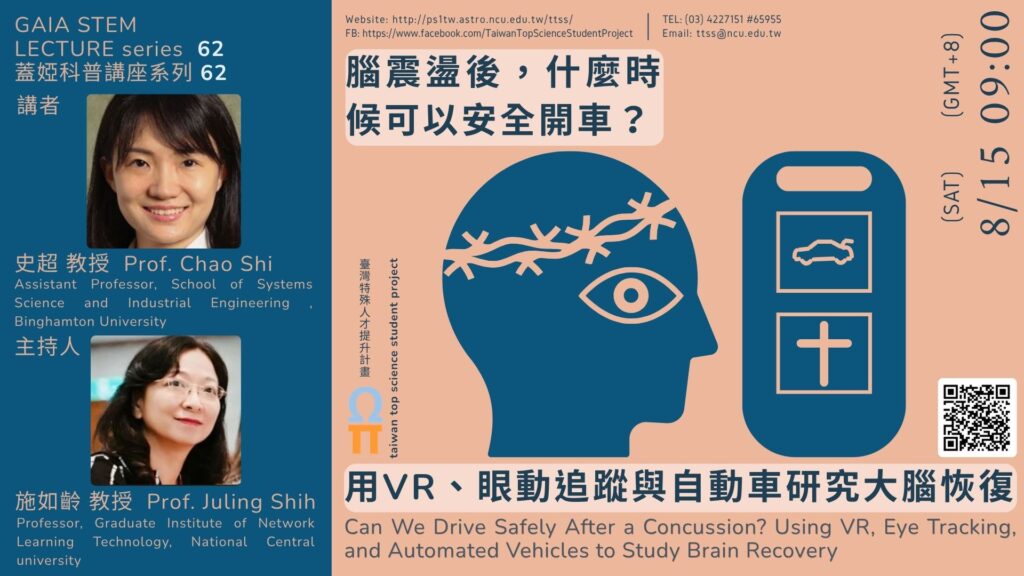
2026/8/15 (六)
上午9:00 (GMT+8) | Can We Drive Safely After a Concussion? Using VR, Eye Tracking, and Automated Vehicles to Study Brain Recovery ( 腦震盪後,什麼時候可以安全開車?用VR、眼動追蹤與自動車研究大腦恢復) – ( 史超 教授 ) |
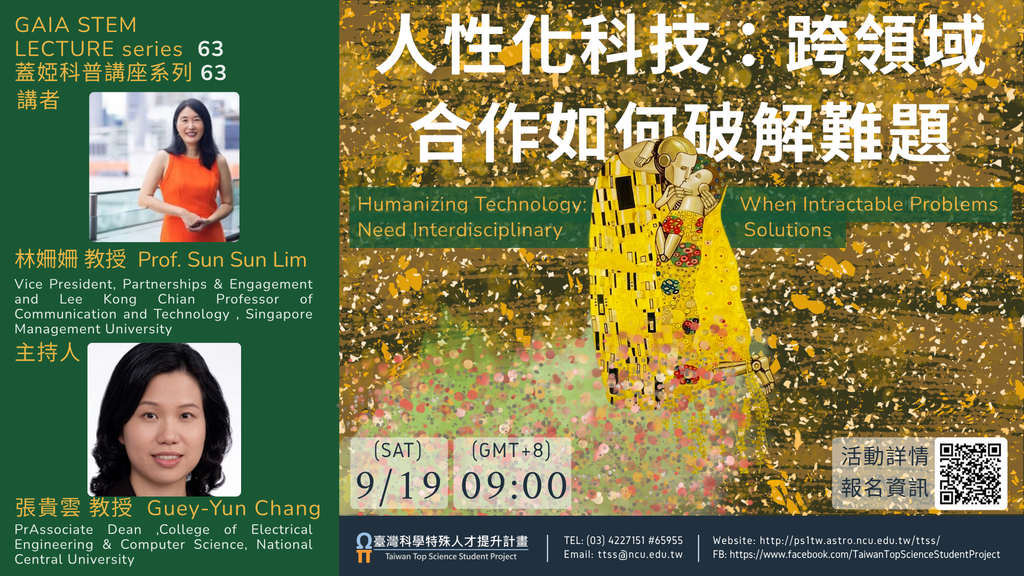
2026/9/19 (六)
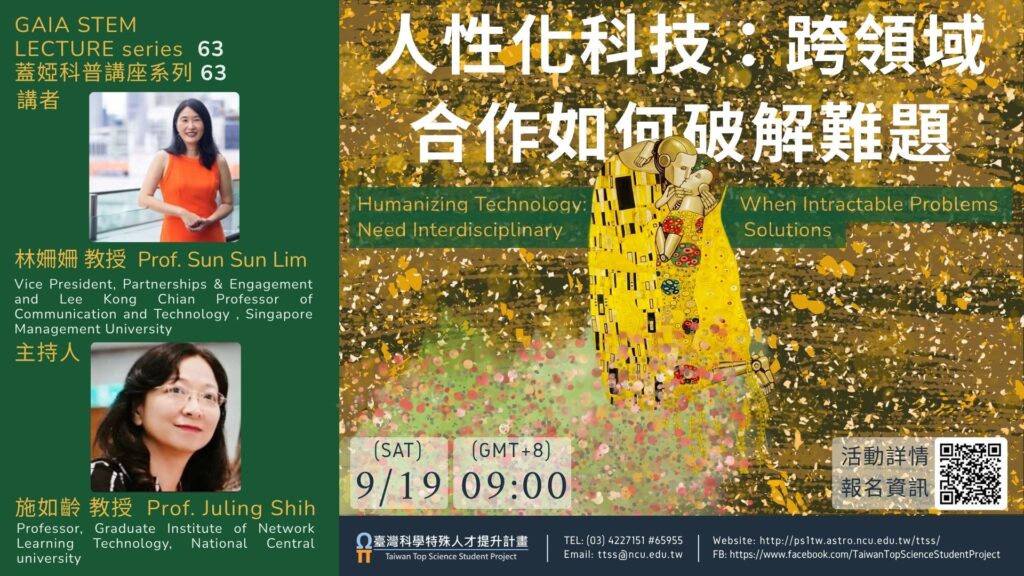
上午9:00 (GMT+8) | Humanizing Technology: When Intractable Problems Need Interdisciplinary Solutions (人性化科技:跨領域合作如何破解難題)
接收報名中! |